
Understanding the off-plan property dubai meaning is the single most important step before entering the UAE real estate market.
Simply put, buying off-plan means purchasing a property directly from a developer before it is completed, often while it is still in the design or early construction stage. In Dubai, off-plan real estate represents a major segment of the housing market, accounting for roughly 7 in 10 residential sales.
Buyers are drawn to these pre-construction developments because they offer discounted launch prices, flexible installment payment plans, and high potential for capital appreciation as construction progresses.
In this complete guide, you will learn exactly how off-plan buying works, how it compares to ready properties, key pros and cons, legal protections under UAE law, and step-by-step buying instructions.
Everything you need to know about off-plan property dubai meaning
Pre-Construction Purchase: You buy a property based on architectural blueprints, 3D renderings, and floor plans before construction finishes.
Flexible Installments: Payments are spread across construction milestones (e.g., 60/40 or 70/30 plans) instead of requiring 100% cash upfront.
Legal Protection: Your money is protected in RERA-regulated bank escrow accounts and registered via DLD Oqood certificates.
Price Discount: Off-plan properties are typically priced 15% to 30% lower than comparable ready-to-move units.
What does off-plan mean in Dubai real estate?
An off-plan property is an unbuilt or under-construction apartment, villa, townhouse, or commercial unit purchased directly from a developer or authorized agent.
how it works
Here is how the general process works:
Project Launch: The developer announces a new project and releases floor plans, pricing, and payment schedules.
Reservation & Booking: You reserve a specific unit by making an initial down payment (usually 5% to 20%).
Signing the SPA: You sign a legally binding Sales and Purchase Agreement (SPA) detailing construction schedules and delivery dates.
Milestone Payments: You pay staggered installments linked directly to verified construction progress over 12 to 36 months.
Handover: Upon final inspection (snagging) and settling the remaining balance, the developer hands over the keys and title deed.
Primary off-plan vs. secondary off-plan: Key differences explained
When exploring the off-plan property dubai meaning, it is helpful to understand the key differences between primary and secondary properties
Primary Off-Plan: You buy a brand-new unit directly from the master developer. You are the first owner.
Secondary Off-Plan: An investor who bought an off-plan unit from a developer resells their contract to you before construction is finished.
Secondary Ready Property: A property that is fully built, previously owned or lived in, and bought directly from the existing owner on the secondary market.
Feature | Off-Plan Property | Secondary (Ready) Property |
|---|---|---|
Handover Timing | 2 to 4 years build timeline | Immediate upon transfer |
Entry Price | 15% to 30% lower than ready | Full market rate |
Payment Method | Staggered developer plan | Full cash or bank mortgage |
Rental Income | Starts after handover | Starts immediately |
Customization | Choose layouts & finishes | Requires renovation costs |
Mortgage Limit | Max 50% LTV during build | Up to 80% LTV available |
Benefits and Risks of Off-Plan Property in Dubai
Why is off-plan property investment in the UAE so popular?
By properly understanding the off-plan property Dubai meaning, you can evaluate the real benefits and risks of this type of investment before buying property in dubai off-plan.
Why Should You Buy Off Plan Property in Dubai? Core financial advantages
Lower Capital Barrier: You can lock in a premium property with a small booking fee (5% to 10%).
High Capital Gains: As surrounding infrastructure grows, property market value climbs before handover, allowing buyers to sell for a profit.
Post-Handover Payment Plans: Many developers allow buyers to pay up to 30% of the property cost after receiving the keys, using rental income to fund ongoing payments.
Brand New Facilities: Units come equipped with modern architectural designs, smart home technology, resort amenities, and energy-efficient systems.
Golden Visa Qualification: Purchasing off-plan property worth AED 2 million or more makes investors eligible for the 10-year UAE Golden Visa.
Pros and Cons of Buying Off-Plan Properties in Dubai
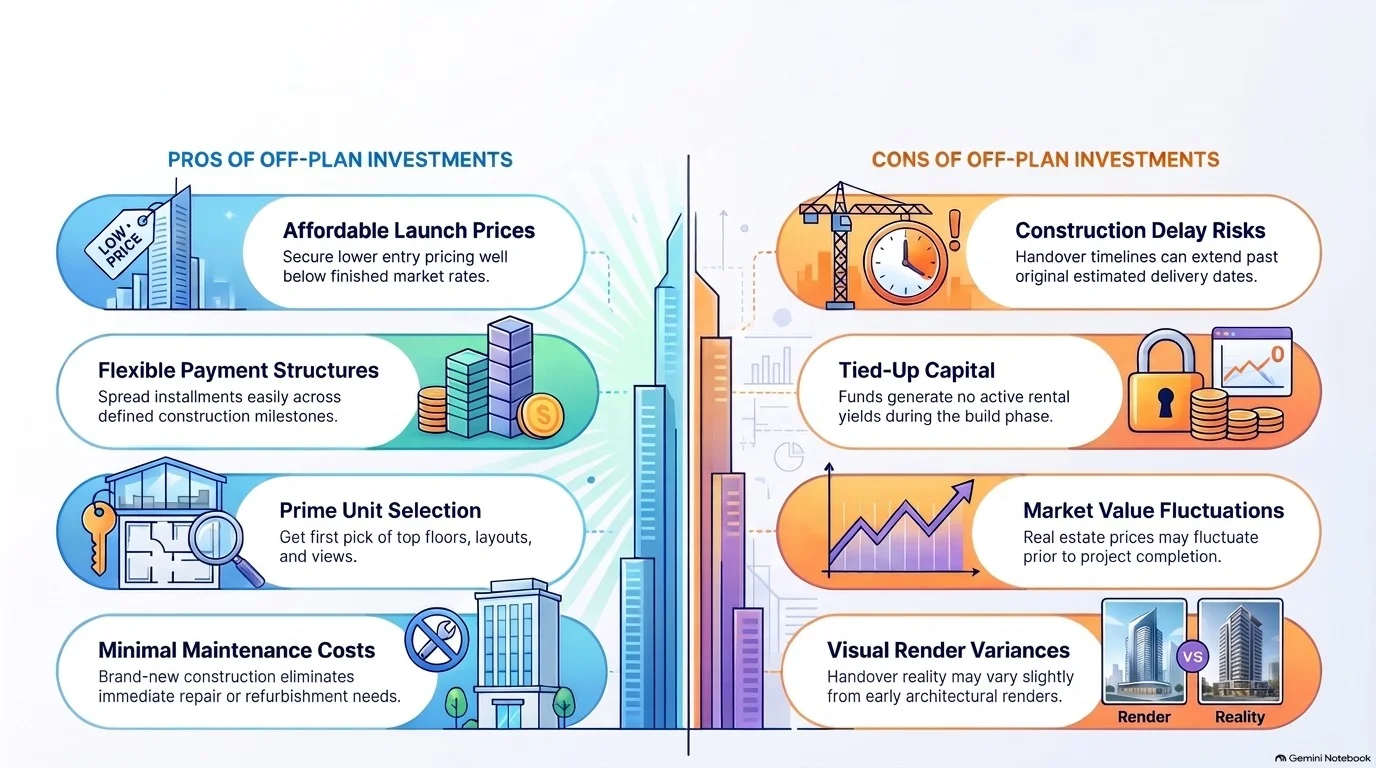
Pros:
Affordable launch entry prices.
Flexible milestone-based payment structures.
First pick of prime floors, layouts, and balcony views.
Minimal maintenance or refurbishment costs.
Cons:
Risk of construction delays.
Capital is tied up without immediate rental income.
Property market fluctuations during construction.
Handover reality may differ slightly from 3D renders.
Off-plan investment in Dubai: how it works step-by-step
Navigating off-plan investment in Dubai: how it works requires following a structured, legal purchase path.
Learning how to buy property in dubai requires signing a Sales Purchase Agreement (SPA) and completing flexible, interest-free installment payments linked to verified building progress up to final handover.
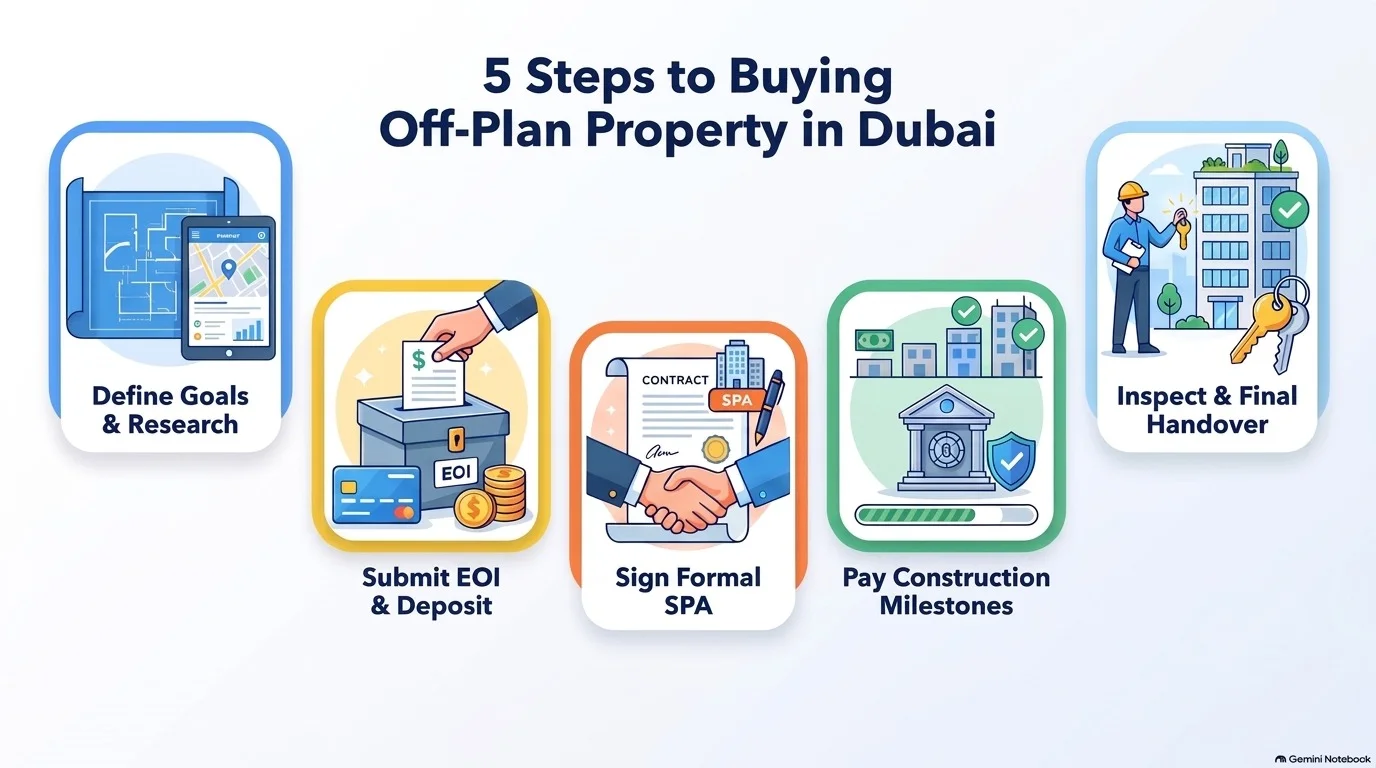
Step 1 to Step 5: From booking deposit to SPA and handover
Define Goals & Research: Set your budget, target yield, and preferred community (such as Downtown Dubai, Dubai Marina, Business Bay, JVC, or Dubai Hills Estate). Verify developer track records on the Dubai REST app.
Submit EOI & Pay Down Payment: For new project launches, submit an Expression of Interest (EOI) and pay a down payment (usually 10% to 20%) plus the 4% DLD registration fee and Oqood fee (~AED 3,000).
Sign the SPA: Review and sign the formal Sales and Purchase Agreement (SPA) outlining payment schedules, delay penalties, and specs.
Pay Construction Installments: Make payments into the project’s official escrow account according to agreed construction milestones.
Snagging Inspection & Handover: Before accepting final keys, inspect the unit (or hire a professional snagging company) to fix minor defects. Settle the final handover balance to receive your ownership documents.
How to sell an off-plan property before completion
If you want to liquidate your investment before completion, you can resell your off-plan unit on the secondary market:
Check Developer Minimum Thresholds: Most major developers (e.g., Emaar) require buyers to have paid off a minimum threshold (typically 30% to 40% of the property value) before granting resale permission.
Find a Buyer & Draft Contract: Agree on the price and premium with a new buyer.
Obtain Developer NOC: Apply for a No-Objection Certificate (NOC) from the developer confirming all current payments are clear.
DLD Transfer: Complete the ownership transfer at a DLD Trustee office. The new buyer assumes all remaining installment obligations outlined in the original SPA.
How to Choose the Right Developer and Community for Off-Plan Buying
Before signing any SPA, identifying reputable real estate companies in dubai with a verified delivery record is as important as comparing floor plans, since the developer’s financial strength and past handover history directly determine whether your project is delivered on schedule.
Best and Most Expensive Areas for Off-Plan Property in Dubai
Best areas in Dubai for off-plan investment combine ultra-luxury waterfront districts with high-yield residential communities.
Choosing the right location is the most critical decision when buying pre-construction homes:
Dubai Maritime City: A rapidly growing coastal hub near Old Dubai and Downtown, offering modern luxury apartments with unobstructed sea views at attractive pre-construction prices and strong capital growth potential.
Business Bay: The city's stylish commercial and residential heart next to Downtown Dubai, and one of the most expensive premium locations for off-plan luxury apartments and branded residences with high tenant demand.
Jumeirah Village Circle (JVC): One of the most popular and affordable off-plan areas, favored by families and young professionals for flexible payment plans and some of the highest long-term rental yields in the market.