
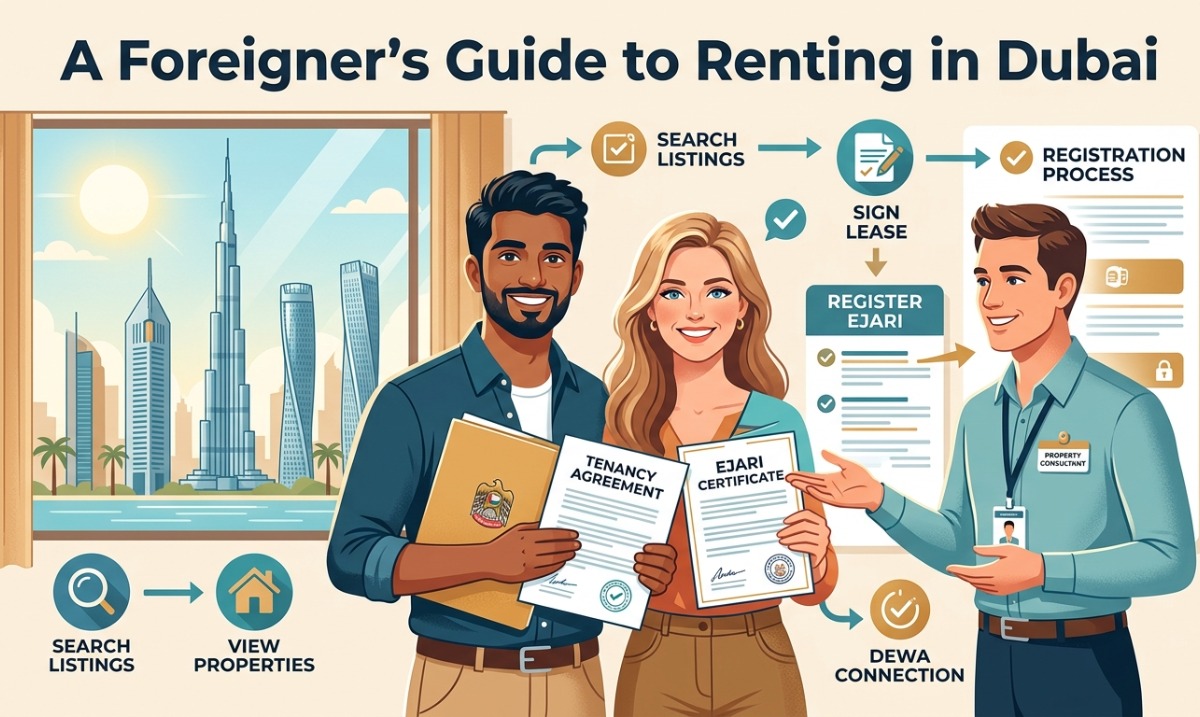
A Foreigner's Guide to Renting in Dubai
Renting in Dubai as an expat works differently than it does in most Western cities. There is no single national rental law covering every emirate — Dubai runs its own system, mainly through RERA (the Real Estate Regulatory Agency) and the Dubai Land Department. If you're looking for a foreigner's guide to renting in Dubai, the process itself is fairly predictable once you know the steps, the paperwork, and the hidden costs that catch most newcomers off guard. Here's what actually happens, step by step, and what it costs.
Who Can Rent in Dubai
You do not need to be a resident to rent in Dubai, but most landlords and agents will ask for a valid UAE residence visa before signing a lease. If you're moving to Dubai for work, your employer visa process and your rental search often happen around the same time. Some landlords accept tenants on a tourist visa for short-term contracts, but this is less common for standard one-year leases.
You'll typically need these documents ready:
- Passport copy (and visa page, once issued)
- Emirates ID (or proof that you've applied for one)
- Salary certificate or employment contract
- Bank statements (usually the last three months)
- Security deposit and post-dated cheques
If you don't have an Emirates ID yet, some agents will let you sign provisionally, but the final tenancy contract (called Ejari) cannot be registered without one.
Renting in Dubai as an Expat: The Basic Process
Search. Start by browsing Properties for Rent in Dubai to get a feel for what's available at different price points before you commit to a neighborhood. If a house with outdoor space matters more to you than a high-rise view, it's worth looking specifically at Villas for rent in Dubai, since villa communities are priced and negotiated differently from apartment towers. For most first-time renters, though, Apartments for rent in Dubai will be the more practical starting point — smaller deposits, shorter commutes in most cases, and more inventory to compare.
View the property. Always view in person if you can. Photos on listings are often outdated or filtered, and things like water pressure, noise from nearby roads, and building maintenance quality don't show up in pictures.
Negotiate. Rents in Dubai are more negotiable than people expect, especially outside peak leasing season (roughly September to December) or if the unit has been vacant for a while.
Sign the tenancy contract. This is a standard RERA-format contract. Read the clauses on maintenance responsibility, renewal terms, and early termination carefully — these vary between landlords.
Register on Ejari. This is mandatory. Ejari is the Dubai Land Department's official register of tenancy contracts. Without an Ejari certificate, you can't get a DEWA (electricity and water) connection, and you may struggle to sponsor family visas or open certain bank accounts.
How Much Does Renting in Dubai Actually Cost?
Rent itself is only part of the bill. Here's what most tenants pay on top of the monthly or annual rent:
- Security deposit: Usually 5% of annual rent for unfurnished units, sometimes 10% for furnished ones. Refundable at the end of the lease, minus any damage costs.
- Agency commission: Typically 5% of the annual rent, paid once, at signing.
- Ejari registration fee: Around AED 220, paid when registering the tenancy.
- DEWA deposit: Around AED 2,000 for an apartment, AED 4,000 for a villa (refundable when you close the account).
- DEWA connection fee: A small one-time charge, usually under AED 100.
- Chiller fees (cooling): Many buildings charge separately for district cooling. This can add several hundred dirhams a month and is easy to overlook when budgeting.
Most landlords still expect rent paid via post-dated cheques commonly one to four cheques per year, sometimes more if you negotiate. Paying in one cheque (annually) often gets you a small discount on the total rent.
A bounced cheque in the UAE used to carry criminal liability; that changed a few years ago, but bounced cheques can still trigger civil penalties and make it very hard to rent again, so don't treat this lightly.
Choosing the Right Area
Dubai's neighborhoods vary enormously in price and lifestyle, and rent for the same size apartment can differ by 40–50% between areas just a few kilometers apart.
- Dubai Marina and JBR: Popular with young professionals, walkable, close to the beach, but often noisy and traffic-heavy on weekends.
- Downtown Dubai: Central, near Burj Khalifa and Dubai Mall, but among the most expensive areas per square foot.
- Jumeirah Village Circle (JVC) and Jumeirah Village Triangle (JVT): More affordable, good for families needing more space, but still a growing area with ongoing construction in parts.
- Business Bay: Central and convenient for commuting, mixed residential and commercial towers.
- Al Barsha, Al Nahda, Deira, Bur Dubai: Older, more budget-friendly areas, often preferred by people prioritizing cost over new amenities.
- Villa communities like Arabian Ranches, Mudon, or The Springs: Suited to families who want a house with a garden rather than an apartment, usually a 20–40 minute drive from central Dubai depending on traffic.
If budget isn't your main constraint and you want to know where the top end of the market sits, this rundown of expensive neighborhoods in Dubai breaks down which areas command the highest rents and why.
Think about your commute before you think about the apartment. Dubai traffic during rush hour can turn a 15-minute drive into 45 minutes, and public transport (the Metro) only covers certain corridors well.
Understanding Your Tenancy Contract
A few points that catch first-time renters off guard:
Rent increases are capped by law based on the RERA rental index, which compares your rent to the average for similar units in the area. If your rent is already close to market rate, the landlord can't raise it much (or at all) at renewal.
Maintenance responsibility is usually split: the landlord handles structural issues and major repairs (AC units, plumbing), while tenants cover minor upkeep. This should be written into the contract, not assumed.
Early termination almost always has a penalty, often equal to one or two months' rent, unless the contract states otherwise.
Notice for non-renewal: Landlords must give 90 days' written notice if they don't intend to renew your contract or want to raise the rent, sent via registered mail or notarized notice — a text message or verbal notice doesn't count legally.
Furnished vs. Unfurnished
Unfurnished apartments in Dubai often come without kitchen appliances, and sometimes without kitchen cabinets or wardrobes at all — this surprises a lot of newcomers used to different rental norms. "Unfurnished" in Dubai can mean bare walls and a shell kitchen. Always ask specifically what's included before signing, and get it listed in the contract, not just promised verbally.
Furnished units cost more (often 15–25% more) but save you the upfront cost and hassle of furnishing an entire home, which matters if you're only planning to stay a year or two.
Dealing with Disputes
If something goes wrong — deposit not returned, landlord not doing agreed repairs, disagreement over the contract — Dubai has a dedicated Rental Dispute Settlement Centre (part of the Dubai Land Department) that handles these cases outside the regular court system. Filing a complaint has a fee based on a percentage of the rental value, and cases typically move faster than general civil court, often resolved within a few weeks to a couple of months depending on complexity.
Keep every piece of documentation: the signed contract, Ejari certificate, payment receipts, and any written communication with your landlord or agent. Verbal agreements carry very little weight if a dispute goes to the tribunal.
A Few Practical Tips for First-Time Renters
Visit the building at different times of day before committing — construction noise, traffic, and sunlight exposure all change dramatically by the hour.
Ask current or former tenants about the building management's responsiveness, not just the landlord. A great apartment with a slow, unresponsive building management company causes more daily frustration than most other factors.
Check the DEWA and chiller costs for that specific building before signing — these vary a lot by property age and cooling system, and older buildings can cost significantly more to cool.
Confirm parking allocation in writing. Some buildings only offer one parking spot per unit regardless of unit size, which matters if you have more than one car.
Rules and typical costs shift over time, so it's worth checking the Dubai Land Department's Ejari portal and RERA's rental index directly before you commit, especially since dispute fees and index calculations get updated periodically.
FAQs
Do I need a UAE residence visa to rent an apartment in Dubai?
Not strictly, but most landlords and agents will only sign a standard one-year lease with tenants who hold a valid residence visa. Without one, your options are mostly limited to short-term or furnished rentals.
How much deposit do I need to rent in Dubai?
Budget for a security deposit of 5% of the annual rent (10% for furnished units), plus a 5% agency commission and a DEWA deposit of around AED 2,000 for an apartment. These are on top of the rent itself, not included in it.
Can my landlord raise my rent every year?
Only within limits. Increases are capped by RERA's rental index, which compares your current rent to the market average for similar units nearby. If you're already paying close to market rate, a large increase isn't legally allowed.